

AI-first means AI agents are the primary way software gets produced, while agentic engineers set direction, judge solutions and outcomes, and make the decisions.
AI-first means AI agents are the primary way software gets produced. The agents plan, build, test and document. Our agentic engineers set direction, judge solutions and outcomes, and make the decisions.
For you as a customer, that means faster delivery, better quality and more becoming possible within the same budget. And there is always a person who takes responsibility for the result. Read more about how we work with you and how we work.
Below, I describe how we got there.
From using AI to being AI-first
Peter Pang, CTO at CREAO, recently wrote about how they went from using AI to becoming AI-first. His description of the journey is recognizable. Almost exactly. But we see it from the other side of the table.
We're a consultancy, so we deliver to others. We deliver to smaller customers and simpler operations, but also to customers in regulated industries — banking and real estate — where requirements on traceability, security, and quality are non-negotiable. That makes the AI-first journey different. And in some ways harder.
Everyone says they use AI. Few have changed how they work.
Peter's point that "AI-first is not the same as using AI" is the most important insight. Most companies we meet have added Copilot to VS Code. Maybe a GPT subscription. Someone has tried Cursor. But the process, the organization, the roles — it all looks the same as before. AI is an add-on to the old way.
For us it's the opposite. AI agents are the primary builders. Humans instruct, review, and accept accountability. It sounds like a small reformulation, but it changes everything. Who you hire. How you estimate. How you price. How you think about quality.
Architect and operator replace junior and senior
Peter talks about the roles Architect and Operator. We see the same. The old division between junior and senior developers loses its meaning. What matters now is whether you can design systems that agents understand, and whether you can review what they produce.
We call it "harness engineering" — the same term Peter uses. The job is to build the environment, the instructions, and the quality controls that allow an AI agent to deliver good work. That's a completely different skill. And it's the skill we sell.
The consulting perspective makes it harder, and more interesting
Peter and CREAO build internally. He can choose monorepo, standardize tooling, control the whole chain. We can't. We step into customers' existing environments. Legacy systems. Proprietary APIs. Organizations that sometimes don't even have their source code under version control.
The difference lies in the process. Agents can quickly map existing systems, identify patterns, generate code and tests. But they need context. Good context. That's where our experience comes in. Building that context, documenting the domain, creating instructions that agents can act on — that's the actual work.
Building a bank with a handful of people
We're currently helping Zinova build the infrastructure for a credit market institution aiming for a banking license. The frontend is built in Lovable. The backend, security, and infrastructure are built by us. With AI agents.
Think about that for a second. A bank. With requirements for traceability, encryption, incident handling, and access control. Built by a team of a handful of people, where a substantial part of the code is produced by AI agents.
That wouldn't have been possible three years ago. Not even a year ago, really. It's possible now because we've built processes, tools, and routines around AI that make it possible to deliver at the quality required.
The system is the product
Peter writes that "prompts are disposable" and that the system is what you build. That matches our experience exactly. We have an internal framework, Fae, that handles how AI agents work against different customers' environments. Tenant isolation, credential management, knowledge context, quality controls.
Frameworks can be copied. Our moat is the process. How we build domain knowledge per customer. How we structure instructions. How we validate AI-generated code intended for production environments. That takes months to build per customer and can't be generated by a prompt.
Management time, same observation
Peter mentions that management time collapsed from 60% to 10%. We see the same pattern. When agents do the heavy lifting, the need for detailed follow-up disappears. You don't need daily standups (hooray!) to ask "how far have you gotten" when you can see it directly in the commit history or in knowledge graphs. You don't need three rounds of estimation meetings.
It frees up time for what actually creates value. Architectural decisions. Customer relationships. Strategic advice. Things AI can't do.
This is a shift
Companies waiting to become AI-first will struggle to compete with those who've already made the transition. That is because the entire delivery model changes.
We're ten people (and growing — apply today!). We deliver to small customers as well as multinational giants. We build what traditional consultancies need 50-100 people for. We do it by working differently.
That's the difference between using AI and being AI-first.

Written by
Daniel Berg
Read more about AI

AI · Magnus Weidmar
What are the benefits of hiring an AI-first consultancy?
Faster delivery, real cost savings without offshore risk, and quality where people stay in control. The concrete benefits of an AI-first consultancy.
Read more
AI · Daniel Berg
Development team as a subscription: what it is and how it works
A development team as a subscription gives continuous delivery at a fixed monthly price. You pay for what is delivered, not for hours.
Read more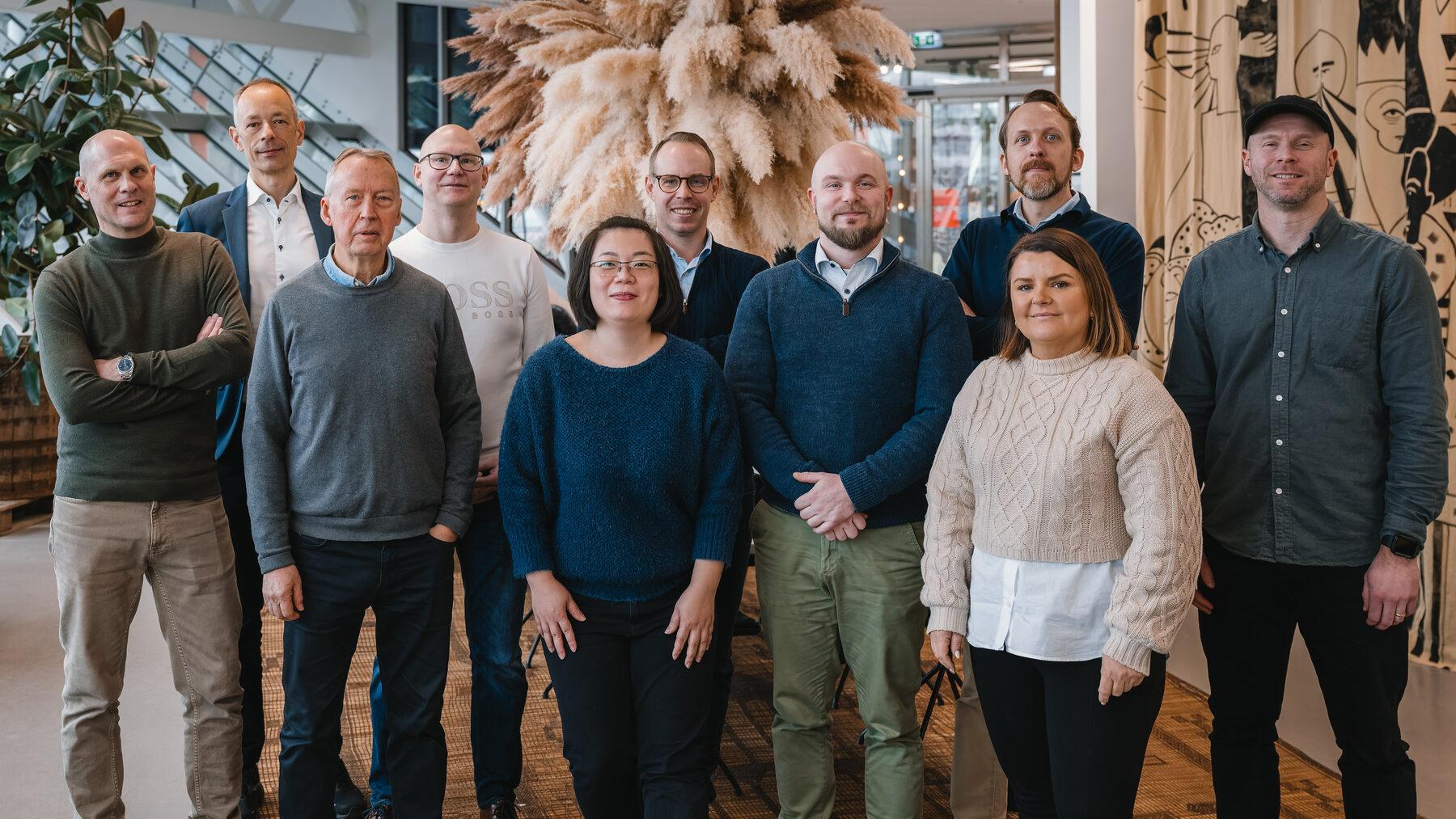
AI · Daniel Berg
What is agentic software development? A practical definition
Agentic software development means AI agents plan, build, test, document and monitor software, while agentic engineers set direction, judge solutions and outcomes, and make the decisions.
Read more